7 Best Careers in a Recession: A 2026 Guide to Bulletproof Your Future

7 Best Careers in a Recession: A 2026 Guide to Bulletproof Your Future
Meta Description: Worried about an economic downturn? Discover the best careers in a recession offering unmatched stability and growth. Read our guide and start preparing now!
Introduction
Economic downturns bring a wave of anxiety, hiring freezes, and widespread layoffs. If you're reading this, you might be worried about the security of your current role or wondering how to pivot before the next wave of economic instability hits. You aren't alone—economic uncertainty is the number one driver of career anxiety today.
While many online resources offer vague advice about "staying positive" or "networking harder" during a recession, they often miss the most crucial factor: industry selection. The reality is that some sectors don't just survive during a recession; they actively thrive.
In this comprehensive guide, we'll dive deeper than generic job search lessons. We will provide data-backed insights into the best careers in a recession, analyze why certain roles are economically bulletproof, and give you actionable steps to pivot your career. Whether you are actively job hunting or just future-proofing your resume, this guide provides the exact blueprint you need.
Why Some Industries Thrive During Economic Downturns
Not all jobs are created equal when the economy shrinks. The secret to finding the best careers in a recession lies in the concept of "inelastic demand." In economics, this refers to goods and services that people must consume regardless of their financial situation or the state of the broader economy.
When consumer spending drops, luxury retail, hospitality, and speculative tech sectors suffer. However, society still needs healthcare, electricity, education, and basic financial management. According to recent labor market analyses, recession-resistant industries experience up to 40% fewer layoffs than high-volatility sectors Harvard Business Review.
The Best Careers in a Recession
If you want to secure your livelihood, here are the top recession-proof career paths to consider:
1. Healthcare Professionals (Nurses, Medical Assistants)
Healthcare is the quintessential recession-proof industry. Illnesses and medical emergencies do not pause for economic downturns.
- Why it's stable: Aging populations and continuous medical needs ensure constant demand. In fact, healthcare jobs historically grow even during severe economic contractions Bureau of Labor Statistics.
- Roles to watch: Registered Nurses (RNs), Respiratory Therapists, and Healthcare Administrators.
2. Public Sector and Government Workers
Local, state, and federal governments must continue to operate. While budget cuts can happen, mass layoffs are incredibly rare compared to the private sector.
- Why it's stable: Government services are essential for infrastructure, public safety, and civic administration.
- Roles to watch: Public School Teachers, Utility Workers, City Planners, and Compliance Officers.
3. Essential IT and Cybersecurity Experts
While experimental tech startups often fold during a recession, enterprise IT and cybersecurity are non-negotiable.
- Why it's stable: Cyber threats actually increase during economic crises. Companies cannot afford a data breach, making cybersecurity a mandatory expenditure Forbes.
- Roles to watch: Information Security Analysts, Cloud Architects, and Systems Administrators.
4. Financial and Accounting Services
During a recession, businesses and individuals become hyper-focused on their finances.
- Why it's stable: Tax laws remain complex, and businesses need accountants to help them restructure debt, manage cash flow, and survive the downturn.
- Roles to watch: Certified Public Accountants (CPAs), Actuaries, and Bankruptcy Specialists.
Vulnerable vs. Recession-Resistant Roles
To give you a clearer picture, here is a comparison of roles that typically struggle versus those that remain stable:
| Industry / Function | Vulnerable Roles (High Risk) | Recession-Resistant Roles (Low Risk) |
|---|---|---|
| Technology | Experimental R&D, UI/UX for Luxury Apps | Cybersecurity, Database Management |
| Finance | Mergers & Acquisitions, Investment Banking | Corporate Accounting, Restructuring |
| Healthcare | Elective Cosmetic Procedures | Emergency Medicine, Elder Care |
| Real Estate | Commercial Real Estate Broker | Property Management, Foreclosure Law |
3 Steps to Pivot to a Recession-Proof Job
If you are currently in a high-risk industry, pivoting might seem daunting. However, you can transition effectively by following these steps:
- Identify Transferable Skills: Audit your current resume. A project manager in hospitality has extreme organizational and budgeting skills that translate perfectly to healthcare administration or government logistics.
- Acquire Micro-Credentials: You don't always need a four-year degree to pivot. Look for industry-recognized certifications (like CompTIA Security+ for IT or specialized coding bootcamps) that signal your competence to employers quickly.
- Optimize Your Resume for Applicant Tracking Systems (ATS): When recessions hit, the volume of applications per job skyrockets. Over 98% of Fortune 500 companies use an ATS to filter candidates Forbes. Your resume must be formatted correctly and contain the exact keywords from the job description to get seen by a human.
What to Do If You're Already in a High-Risk Industry
If you can't immediately change careers, you need to make yourself indispensable in your current role.
Do's and Don'ts for Job Security:
- DO volunteer for revenue-generating projects. If you directly tie your work to the company's survival, you are less likely to be cut.
- DO upskill on your own time. Learn the software or processes that your managers care about most.
- DON'T isolate yourself. Internal networking is just as important as external networking; make sure decision-makers know your value.
- DON'T ignore market signals. If your company freezes hiring and cuts the marketing budget, start preparing your exit strategy immediately.
Secure Your Future with JobSeekerTools
Transitioning into one of the best careers in a recession requires more than just good intentions—it requires flawless execution. Whether you need to highlight your transferable skills or ensure your resume beats strict Applicant Tracking Systems, JobSeekerTools is your ultimate advantage.
Our intelligent resume builder, tailored cover letter generators, and job-matching algorithms are designed specifically to help you pivot industries seamlessly. Don't leave your career to chance during an economic downturn. Let JobSeekerTools help you land a stable, high-paying role today.
Conclusion
Economic downturns are inevitable, but career stagnation is not. By understanding which industries rely on inelastic demand—like healthcare, government, essential IT, and accounting—you can proactively position yourself in a role that offers long-term stability. Remember, the best time to prepare for a recession is before it happens. Analyze your skills, target recession-resistant sectors, and use the right tools to bulletproof your career.
Visual Guides
Infographic: The Anatomy of a Recession-Proof Job
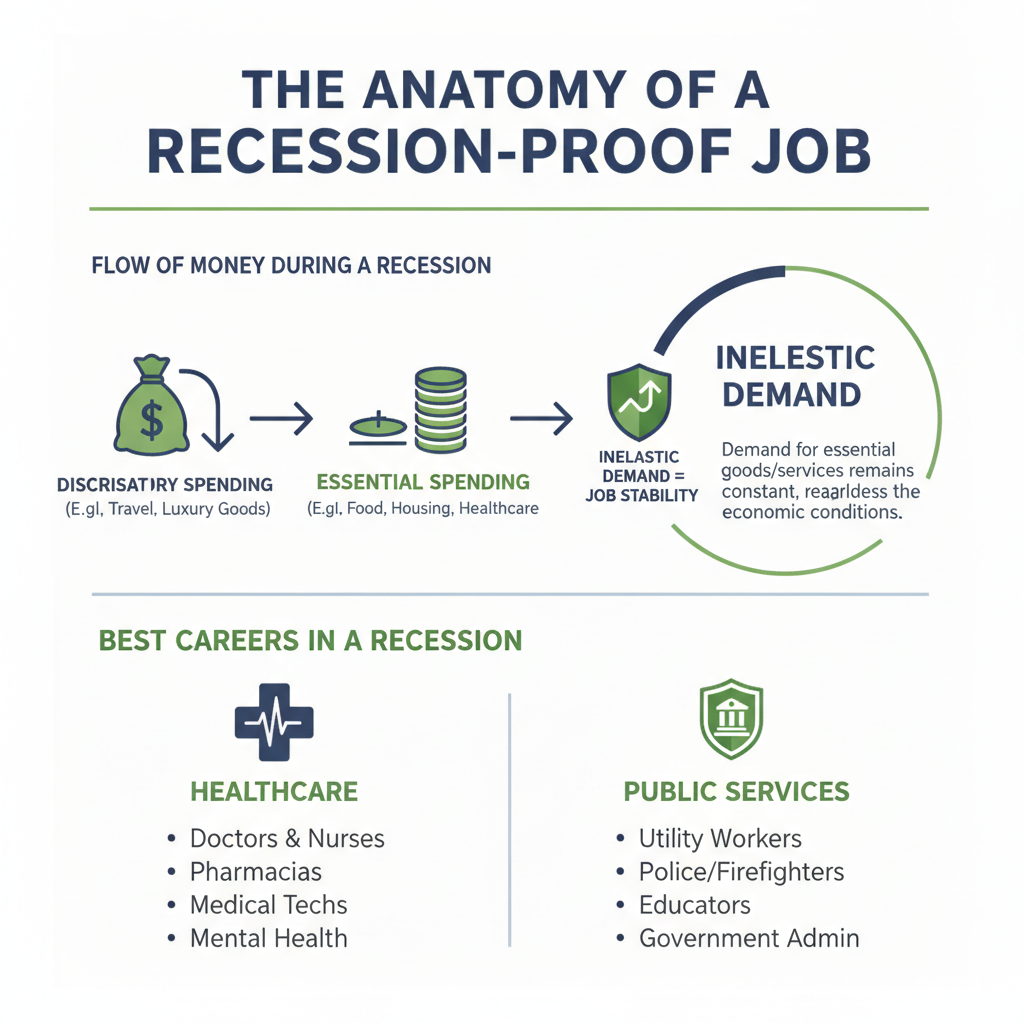
The Flow of Money During a Recession
- Consumer Behavior Shifts: Discretionary spending plummets while essential spending remains stable.
- Corporate Budgets Tighten: Businesses reduce non-essential investments, marketing, and expansion efforts.
- Government Spending Increases: Funding often flows into public services, infrastructure, and social safety nets to stimulate the economy.
The Power of Inelastic Demand
Inelastic demand means consumers and organizations must continue to purchase these goods and services regardless of economic conditions.
Key Drivers of Inelastic Demand:
- Necessity: Basic human needs (health, food, safety).
- Compliance: Regulatory and legal requirements (accounting, law).
- Public Infrastructure: Services required for society to function (utilities, education).
Protected Sectors & Job Security
🏥 Healthcare
- Why it's safe: Illness and aging do not pause for economic downturns.
- Roles: Nurses, Medical Assistants, Healthcare Administrators.
- Data Point: Healthcare consistently adds jobs even during broad economic recessions.
🏛️ Public Services & Government
- Why it's safe: Funded by taxes rather than corporate profits, providing stability.
- Roles: Teachers, Public Safety Personnel, Urban Planners.
- Data Point: Government employment sees far lower volatility compared to the private sector.
🔒 Utilities & Essential Services
- Why it's safe: Energy, water, and waste management are non-negotiable for modern living.
- Roles: Electrical Engineers, Plant Operators, Cybersecurity Analysts (protecting critical infrastructure).
- Data Point: Essential service sectors experience near-zero demand elasticity during economic crises.
Comparison Chart: Job Security by Sector
The Vulnerability Gap During Economic Downturns
- High Volatility Sectors: Industries reliant on consumer discretionary income or heavy corporate investment see immediate and sharp reductions in workforce.
- High Stability Sectors: Industries providing essential services or mandated compliance experience steady or even increased demand for talent.
Vulnerable Industries (High Average Layoff Rates)
These sectors often see double-digit layoff rates during severe economic recessions as consumers and businesses reduce non-essential spending.
🛎️ Hospitality & Tourism
- Why it's vulnerable: Travel, leisure, and dining out are often the first expenses consumers cut when personal budgets tighten.
- Impact Factor: Highly sensitive to consumer confidence and reductions in disposable income.
🛍️ Luxury Retail
- Why it's vulnerable: Non-essential, high-ticket items experience a drastic drop in sales as buyers delay major purchases during uncertain times.
- Impact Factor: Heavily dependent on the wealth effect and overall economic optimism.
Stable Industries (Low Average Layoff Rates)
These sectors maintain low, single-digit layoff rates—and often continue hiring—during economic downturns due to inelastic demand.
🛡️ Cybersecurity & Tech Infrastructure
- Why it's safe: Data protection and digital infrastructure remain critical for businesses regardless of their current revenue. The cost of a security breach far outweighs the cost of maintaining security personnel.
- Impact Factor: Essential for basic operational continuity, legal compliance, and ongoing risk management.
🩺 Nursing & Healthcare Services
- Why it's safe: Medical needs are non-negotiable. Aging populations and unexpected illnesses require consistent, continuous care regardless of the broader economy.
- Impact Factor: Driven by fixed demographic trends and fundamental human necessities rather than volatile economic cycles.
Frequently Asked Questions
Are tech jobs safe during a recession? It depends on the sub-sector. While consumer-facing tech and experimental startups often experience layoffs, essential enterprise IT, database management, and cybersecurity are typically highly recession-resistant because businesses rely on them to function.
Do I need a new degree to transition into a recession-proof career? Not necessarily. Many recession-proof roles prioritize specific skills and certifications over traditional degrees. Identifying your transferable skills and obtaining targeted micro-credentials or certifications is often a faster and more effective way to pivot.
How can I tell if my current job is at risk? Warning signs include company-wide hiring freezes, cuts to non-essential budgets (like travel or training), delayed product launches, and executive turnover. If your role does not directly contribute to the company's core revenue or essential operations, it may be at higher risk.