How to List Shadowing on Resume in 2026: The Definitive Guide (with Examples)
How to List Shadowing on Resume in 2026: The Definitive Guide (with Examples)
Have you recently spent time observing a professional in a field you're passionate about, only to find yourself completely stuck when it's time to update your resume? You're not alone. Many job seekers, especially recent graduates or career changers, struggle with how to list shadowing on resume effectively.
While some candidates leave it off entirely—missing a golden opportunity to showcase their proactive nature—others bury it so deep that Applicant Tracking Systems (ATS) and hiring managers completely miss it. Considering that a significant percentage of large employers use ATS software to filter candidates Harvard Business School Study on Hidden Workers, getting your resume formatting right is not just an option; it's a necessity.
In this comprehensive guide, we won't just tell you to "put it under experience." We'll dive into exactly where it belongs, how to write compelling bullet points, and provide real-world examples that you can use today to stand out.
Why Job Shadowing is a Resume Power-Up
Job shadowing is more than just "following someone around." It demonstrates initiative, a genuine interest in the industry, and provides you with a foundational understanding of day-to-day operations. Before we dive into the "how," let's establish why it's crucial:
- Shows Proactive Interest: It proves you go above and beyond to learn about your chosen field.
- Bridges Experience Gaps: For entry-level candidates, it acts as a valuable substitute for formal work experience.
- Highlights Soft Skills: It subtly communicates your communication skills, professional curiosity, and willingness to learn.
Where Does Shadowing Belong on Your Resume?
The biggest flaw in most advice is treating every resume the same. The optimal placement for your shadowing experience depends entirely on your career stage and the relevance of the shadowing to the job you're applying for.
1. In the "Work Experience" Section
Best for: Recent graduates or those with very limited formal work history.
If your resume is looking a little light on traditional jobs, treat your shadowing experience as an unpaid internship. Create an entry under your Work Experience section.
2. In a Dedicated "Clinical Experience" or "Shadowing Experience" Section
Best for: Medical, dental, nursing, or pre-med students.
In healthcare and clinical fields, shadowing is often a formal prerequisite. Creating a dedicated section highlights this specific, highly relevant observation time.
3. In the "Education" Section
Best for: When the shadowing was a required component of a specific class or degree program.
If you earned academic credit for the shadowing, it can naturally nest under the relevant degree or coursework.
Step-by-Step: How to Format Shadowing on Your Resume
To ensure your resume passes both the ATS scan and the human eye test, follow these steps:
- List the Professional's Name and Title: If applicable and you have their permission (e.g., Dr. Jane Smith, Lead Cardiologist). Alternatively, list the Department or Team.
- Include the Company or Organization Name: Provide the name of the clinic, firm, or business.
- Specify the Location: City and State are sufficient.
- Note the Dates/Duration: Provide the month and year, and optionally, the total number of hours (e.g., "June 2025 - August 2025 (40 Hours)"). Total hours are especially important in medical fields.
- Write Action-Oriented Bullet Points: Don't just list what the other person did. Describe what you learned, observed, or assisted with.
💡 Pro Tip: Struggling to optimize these bullet points for a specific job? Try JobSeekerTools. Our advanced resume builder and ATS optimization tools can analyze your target job description and help you tailor your shadowing bullet points to match the exact keywords recruiters are looking for.
Real-World Examples of Shadowing on a Resume
Let's look at how this translates into actual resume entries. Notice how we use strong action verbs even for observational roles.
Example 1: Tech Industry (Under Work Experience)
Job Shadow, UX Design Team TechInnovate Solutions, Austin, TX | May 2025 – June 2025 (20 hours)
- Observed lead UX designers during user testing sessions for a new mobile application prototype.
- Participated in daily stand-up meetings, gaining exposure to Agile development methodologies.
- Synthesized observation notes into a summary report of common user pain points for the design team.
Example 2: Medical Field (Under Dedicated Section)
Clinical Shadowing Experience Dr. Robert Chen, Pediatric Clinic, Seattle, WA | January 2026 – March 2026 (50 Total Hours)
- Shadowed Dr. Chen during routine pediatric check-ups and minor in-office procedures.
- Gained familiarity with patient intake processes, bedside manner best practices, and HIPAA-compliant documentation procedures.
- Observed the diagnosis and treatment planning for common pediatric illnesses.
The Do's and Don'ts of Listing Job Observation
Keep these best practices in mind to avoid common pitfalls:
- DO focus on the specific skills or methodologies you were exposed to.
- DO use industry-specific keywords (LSI keywords like clinical shadowing, job observation, professional shadowing).
- DO quantify the experience if possible (number of hours, number of departments observed).
- DON'T exaggerate your role. Be clear that you were observing or shadowing, not leading or executing the tasks independently.
- DON'T include shadowing from years ago if you now have substantial, relevant work experience.
Navigating Resume Tenses for Shadowing
One of the most common formatting errors is using the wrong tense. Use this quick reference table to get it right every time:
| Situation | Tense to Use | Example Bullet Point |
|---|---|---|
| You are currently shadowing | Present Tense | Observe daily surgical procedures... |
| The shadowing is completed | Past Tense | Observed daily surgical procedures... |
Conclusion
Knowing how to list shadowing on resume doesn't have to be a roadblock. By strategically placing it in the right section, formatting it clearly with total hours and dates, and writing bullet points that focus on what you learned, you transform a simple observation into a compelling professional asset. Remember, the goal is to show employers your proactive dedication to your career path.
Visual Guides
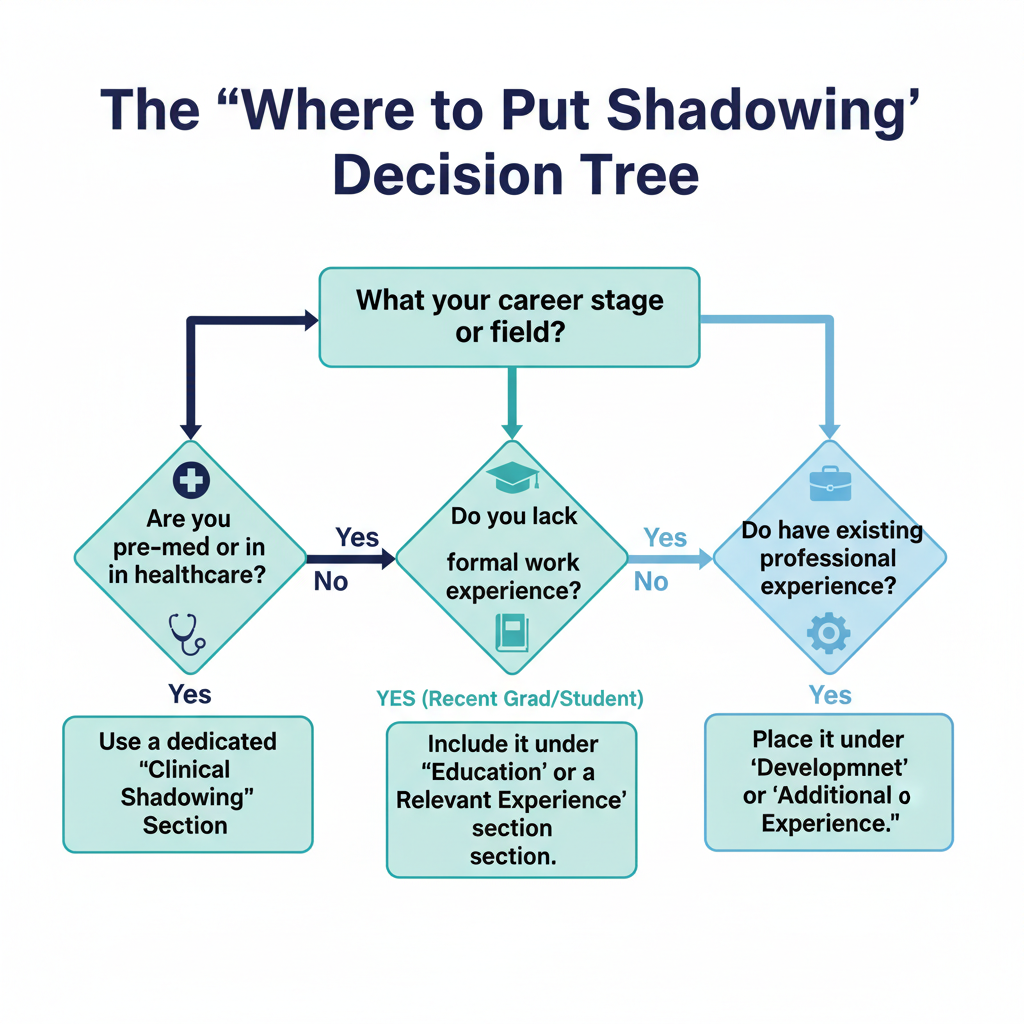
The "Where to Put Shadowing" Decision Tree
A guide to determining the best place on your resume for your shadowing experience.
🔍 Decision Flow
1. Are you a pre-med, nursing, or healthcare student?
- Yes: Create a dedicated "Clinical Shadowing" section. (This is standard industry practice).
- No: Move to the next question.
2. Do you have significant, relevant work experience?
- Yes: Include it as a brief bullet point under "Education" or a "Professional Development" section. (Avoid cluttering your main Work Experience section).
- No (Entry-level / Recent Grad): Move to the next question.
3. Was the shadowing extensive, structured, and highly relevant to the role?
- Yes: List it under "Related Experience", "Projects", or create a custom "Shadowing Experience" section. Treat it similar to an internship.
- No (Brief or informal): Include it under your "Education" section as an extracurricular activity, relevant coursework component, or under a general "Extracurriculars" section.
💡 Key Takeaways
- Relevance is Key: Only include shadowing if it aligns with the job you are applying for.
- Be Honest: Never list shadowing as standard "Employment" or "Work Experience" to avoid misleading recruiters.
- Focus on Learnings: Regardless of where it lives on your resume, highlight what you observed and the skills you gained exposure to.
Weak vs. Strong Shadowing Bullet Points
A side-by-side comparison to help you transform passive observations into impactful resume accomplishments.
🆚 Side-by-Side Comparison
❌ The Weak Approach
- "Watched someone code."
- The Problem: This is passive, vague, and lacks professional terminology. It doesn't tell the recruiter what you actually learned or what technologies were involved.
✅ The Strong Approach
- "Observed senior developers during Agile sprints, gaining exposure to Python deployment pipelines."
- The Solution: This approach uses professional action verbs ("Observed"), specifies the environment ("Agile sprints"), names the roles involved ("senior developers"), and highlights the specific technical skills gained ("Python deployment pipelines").
💡 Key Takeaways
- Use Active Verbs: Replace passive words like "watched" or "saw" with professional verbs like "observed," "analyzed," or "shadowed."
- Include Specifics: Mention the exact tools, methodologies, or processes you were exposed to during your time shadowing.
- Provide Context: Explain who you shadowed and the professional environment to give depth and credibility to your experience.
Frequently Asked Questions
Is job shadowing considered work experience?
Job shadowing is generally considered an observational learning experience rather than formal work experience. However, if you are a recent graduate with limited employment history, you can list it under your Work Experience section to demonstrate proactive industry engagement and relevant exposure.
How many hours of shadowing should I put on a resume?
You should list the total number of hours if it is significant or required by your field (especially common in healthcare, where 40-100+ hours might be expected). If it was just a one-day, 4-hour experience, it's usually better to list the month and year rather than the specific low hour count, focusing instead on the key takeaways.
Do employers verify shadowing on a resume?
While less scrutinized than a formal salaried position, employers may verify shadowing, especially in highly regulated fields like medicine or finance. They might contact the professional you listed or check with the organization. Always be honest and ensure you have permission from the person you shadowed before listing their name.