Top 50+ Skills to Put on a Resume for Students (2026 Guide & Examples)
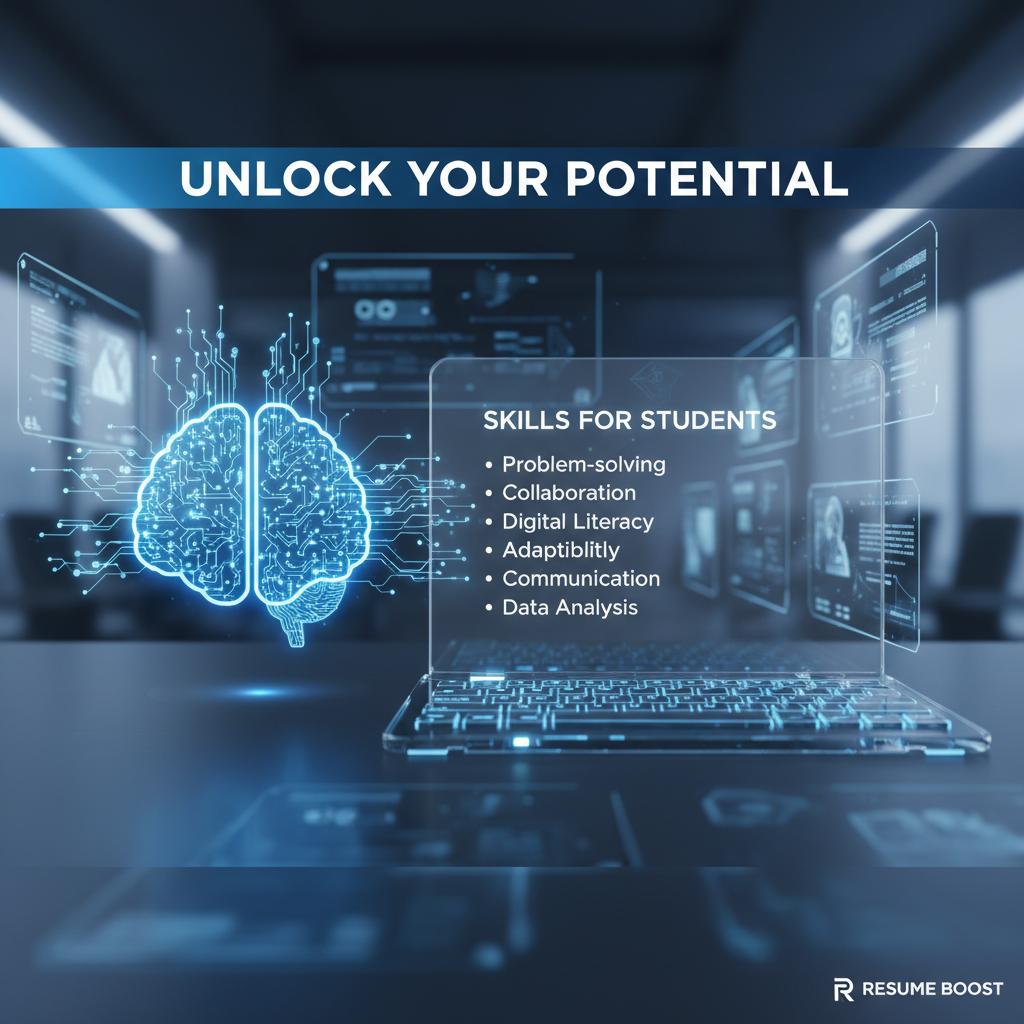
Top 50+ Skills to Put on a Resume for Students (2026 Guide & Examples)
Introduction
"I have no professional experience, what can I even put on my resume?"
If you're a high school or college student, you've likely stared at a blank Word document thinking exactly this. It's the classic catch-22: you need experience to get a job, but you need a job to get experience.
The good news? You already possess highly marketable skills. The challenge isn't acquiring them; it's identifying and translating them into language that recruiters and Applicant Tracking Systems (ATS) understand. While other resources might offer generic advice about listing coursework and ditching the "objective" section, this guide provides a superior, actionable framework. We will dive deep into the exact skills to put on a resume for students, providing real-world examples, proper formatting techniques, and the strategic edge you need to outshine your competition.
Analyzing the Standard Advice (And Why It's Not Enough)
When looking at standard industry advice—such as Jobscan's guide for college student resumes—the structural recommendations are solid. They correctly advise students to focus on coursework, internships, GPA, volunteer experience, and extracurricular activities.
However, many of these guides fail to connect the dots. They tell you where to look for experience but don't explain how to extract the specific, hirable skills from those experiences. Listing "President of Debate Club" is good; extracting "Public Speaking," "Persuasion," and "Conflict Resolution" is what actually gets you the interview. We are going to bridge that gap by showing you how to translate academic life into professional skills.
Understanding Hard Skills vs. Soft Skills
Before listing skills, you need to understand the two main categories employers look for:
- Hard Skills: Teachable, measurable abilities (e.g., Python, Spanish, Adobe Photoshop, Data Analysis).
- Soft Skills: Interpersonal and behavioral traits (e.g., Leadership, Adaptability, Time Management).
Did you know that 75% of resumes are rejected by an ATS before a human ever sees them? Forbes. To pass these digital gatekeepers, you need a healthy, targeted mix of both hard and soft skills.
The Best Soft Skills to Put on a Resume for Students
Soft skills are highly transferable, meaning they apply to almost any industry. As a student, you practice these daily.
- Communication: Writing research papers (Written Communication) or presenting group projects (Verbal Communication).
- Time Management: Balancing an 18-credit semester, a part-time job, and intramural sports.
- Problem-Solving: Troubleshooting a failed chemistry experiment or resolving a scheduling conflict for a campus event.
- Teamwork & Collaboration: Working seamlessly with diverse classmates on a semester-long capstone project.
- Adaptability: Successfully pivoting to remote learning or adjusting to sudden syllabus changes.
The Best Hard Skills to Put on a Resume for Students
Hard skills will vary wildly depending on your major, but here are universally valuable technical skills you likely picked up in school:
- Data & Analytics: Microsoft Excel (Pivot Tables, VLOOKUP), Google Analytics, SPSS, basic statistics.
- Digital Tools: Google Workspace, Microsoft Office Suite, Slack, Zoom, Trello, Asana.
- Design & Content: Canva, Adobe Creative Cloud, WordPress, basic HTML/CSS.
- Language: Fluency or professional working proficiency in a second language.
- Research: Academic research, data collection, surveying, literature reviews.
How to Identify Your Hidden Skills (Step-by-Step)
Don't just guess what to include. Follow this structured approach to mine your background for the best skills to put on a resume for students:
- Audit Your Coursework: Look at your syllabi. Did you write a 20-page thesis? That's "Long-form Writing" and "Academic Research."
- Review Extracurriculars: Did you manage the budget for your fraternity/sorority? That's "Financial Management" and "Budgeting."
- Analyze Part-Time Jobs: Flipping burgers or working retail isn't just a paycheck. It demonstrates "Customer Service," "Conflict Resolution," and "Cash Handling."
- Match with the Job Description: Highlight the required skills in the job posting and draw lines to your audited list. Only include the skills relevant to the job you are applying for.
Formatting Your Skills: The "Do's and Don'ts"
How you present your skills is just as important as the skills themselves.
The Do's:
- DO use exact keywords from the job description.
- DO group your hard skills into logical categories (e.g., "Software," "Languages," "Lab Techniques").
- DO weave soft skills into your experience bullet points rather than just listing them.
The Don'ts:
- DON'T lie or exaggerate your proficiency level.
- DON'T list outdated or irrelevant skills (e.g., MS Paint).
- DON'T use subjective rating systems (like drawing 3 out of 5 stars next to a skill).
Proving Your Skills: Phrasing Matters
When writing your bullet points in the Experience or Project sections, you must prove your skills through action and results.
| Weak Phrasing (Tells) | Strong Phrasing (Shows & Proves) |
|---|---|
| "Worked on a group project." | "Collaborated with a 5-person team to research and present a 30-minute marketing strategy." |
| "Used Excel for data." | "Analyzed over 2,000 rows of survey data using Excel PivotTables to identify student trends." |
| "Was a shift leader at a cafe." | "Managed a team of 4 baristas during peak hours, ensuring fast customer service and resolving complaints." |
Notice the shift from passive, past-tense descriptions to active, impact-driven statements.
The Ultimate Shortcut: Let JobSeekerTools Help
Trying to perfectly align your student resume with a complex job description can be overwhelming. This is where JobSeekerTools steps in. Instead of guessing which keywords the ATS is looking for, you can use our platform to instantly analyze your resume against the job description. JobSeekerTools will identify the exact missing skills to put on a resume for students, helping you optimize your application in seconds and significantly boosting your chances of landing an interview.
Conclusion
You don't need decades of professional experience to build an impressive resume. By dissecting your coursework, part-time jobs, and extracurriculars, you can uncover a wealth of highly hirable hard and soft abilities. Remember, the best skills to put on a resume for students are the ones that directly align with the job description, backed up by concrete examples from your academic and personal life. Take the time to tailor your skills, and you'll transform your blank page into a compelling professional story.
Key Resources
The Ultimate Student Resume Checklist
Caption: Printable checklist to find hidden skills to put on a resume for students without work experience
Academic Achievements
- List all relevant coursework and seminars attended
- Include significant academic projects and research papers
- Note academic honors, scholarships, or Dean's list awards
- Highlight language proficiency and study abroad experiences
Extracurricular Activities
- Document club memberships, society affiliations, and your specific roles
- Record volunteer work, community service, and hours contributed
- List any sports, arts, or other organized team activities
- Note leadership positions held (e.g., event coordinator, treasurer, team captain)
Technical & Soft Skills
- Identify software, tools, and platforms used in classes or personal projects
- Detail communication skills developed through presentations and debates
- Highlight teamwork and collaboration experience from group projects
- Add any self-taught skills (e.g., coding, graphic design, video editing)
Professional Presentation
- Ensure strong action verbs are used for all experience descriptions
- Quantify achievements where possible (e.g., "Led a team of 5", "Raised $500")
- Proofread meticulously for grammar, punctuation, and spelling errors
- Have a peer, mentor, or career advisor review the draft resume
Hard Skills vs. Soft Skills Infographic
Caption: Infographic highlighting the top hard and soft skills to put on a resume for students
🖥️ Hard Skills
- Data Analysis
- Project Management
- Software Development / Coding
- Cloud Computing
- Digital Marketing
- Search Engine Optimization (SEO)
- Foreign Language Proficiency
- Technical Writing
- User Interface/User Experience (UI/UX) Design
- Financial Accounting
🤝 Soft Skills
- Communication
- Teamwork & Collaboration
- Problem-Solving
- Time Management
- Adaptability & Flexibility
- Critical Thinking
- Emotional Intelligence
- Leadership
- Creativity
- Conflict Resolution
Frequently Asked Questions
Should I list soft skills in a dedicated "Skills" section? Generally, it's better to weave soft skills into your experience or project bullet points where you can provide context. Reserve your dedicated "Skills" section for hard, technical skills, software, and languages that can be quickly scanned by a recruiter.
What if I don't have any technical hard skills yet? Focus heavily on the digital tools you use every day for school (Google Workspace, Microsoft Office, research databases). If you know your target industry requires a specific tool, consider taking a free weekend course online to learn the basics so you can list it.
How many skills should I list on my resume? Aim for 6 to 10 highly relevant hard skills in your dedicated skills section. It's better to list 6 skills you are proficient in and are relevant to the job than 15 skills you barely know. Quality always beats quantity.