Top Ten List to Become a Critical Thinker: Master the Skill Employers Want Most in 2025

Top Ten List to Become a Critical Thinker: Master the Skill Employers Want Most in 2025
In an age where AI can write code and algorithms can predict market trends, one human skill remains irreplaceable: Critical Thinking.
It’s the difference between following instructions and leading innovation. It’s why some candidates get the job offer while others get the "we'll keep your resume on file" email.
But here is the harsh reality: A staggering 70% of corporate leaders report a critical skills gap in their organizations, with strategic and critical thinking identified as the top soft skill needed right now Springboard for Business 2024 State of the Workforce Report.
If you feel like you're stuck in your career or struggling to stand out in interviews, the problem might not be your technical qualifications—it might be how you think.
This isn't just another generic advice column. This is your comprehensive, actionable guide to mastering the art of critical analysis. We’ve analyzed the competition, stripped away the fluff, and built the ultimate top ten list to become a critical thinker that will transform your job search and your career.
What is Critical Thinking? (And Why Most People Get It Wrong)
Critical thinking isn't about being negative or argumentative. It is the ability to analyze information objectively, evaluate evidence, and make reasoned judgments. It involves questioning assumptions—including your own—and connecting dots that others might miss.
Most job seekers list "Critical Thinking" as a bullet point on their resume. Today, you learn how to actually embody it.
The Definitive Top Ten List to Become a Critical Thinker
To become a powerhouse thinker, you need to develop these ten core competencies. We've ranked them from foundational to advanced.
1. Objective Analysis (The Foundation)
Before you can solve a problem, you must understand it without bias. Objective analysis means stripping away your personal feelings and looking at the raw data.
- Actionable Tip: When faced with a workplace issue, write down the facts in one column and your opinions in another. Deal only with the first column.
2. Open-Mindedness (The Filter)
A closed mind is a dead end. Critical thinkers actively seek out information that contradicts their current beliefs.
- The Challenge: Next time you disagree with a colleague's strategy, argue for their side for five minutes. You’ll be surprised at what you discover.
3. Effective Problem Solving (The Action)
Employers don't pay you to spot problems; they pay you to fix them. This skill moves you from "It's broken" to "Here is the solution."
- Resume Hack: Don't just say "Problem Solver." Use the STAR method (Situation, Task, Action, Result) to describe a specific time you fixed a costly error.
4. Communication (The Bridge)
You can have the most brilliant idea in the world, but if you can't explain it clearly, it's worthless. Critical thinking requires articulating complex ideas simply.
- Stat: 55% of executives report critical thinking as the most needed skill for future job success, and communication is the vehicle for that thinking World Economic Forum Future of Jobs Report 2023.
5. Active Listening (The Input)
You cannot think critically if you aren't hearing the full story. Active listening means listening to understand, not just waiting for your turn to speak.
- Technique: Practice "reflective listening." After someone speaks, paraphrase their point back to them: "So, what you're saying is..."
6. Creativity & Innovation (The Spark)
Logic handles the known; creativity handles the unknown. Critical thinkers use creativity to find non-obvious solutions to old problems.
- Example: If a marketing channel stops working, a reactive thinker increases the budget. A critical thinker invents a new channel.
7. Inference & Logical Reasoning (The Connection)
This is the ability to draw conclusions from limited data. It’s reading between the lines to predict future outcomes.
- Workplace Application: If sales dipped in Q3 for the last three years, you can infer they might dip again this year and plan a proactive campaign.
8. Self-Regulation (The Mirror)
This is the ability to monitor your own thought processes and correct them. It’s asking, "Am I tired? Am I biased because I don't like this client?"
- Checklist: Before sending a heated email, check your emotional state. Are you reacting to the facts or the tone?
9. Observation (The Lens)
Details matter. Critical thinkers notice subtle changes in their environment, data, or team dynamics that others ignore.
- Daily Habit: Spend 5 minutes a day reviewing your team's workflow. What is one small bottleneck no one else has noticed?
10. Curiosity (The Fuel)
The phrase "because we've always done it this way" is the enemy of critical thinking. Curiosity drives you to ask "Why?" and "What if?"
- The 5 Whys: When a problem occurs, ask "Why?" five times to get to the root cause, rather than just treating the symptom.
Reactive vs. Critical Thinker: A Comparison
To help you visualize the difference, here is how a Reactive Thinker handles a situation versus a Critical Thinker.
| Feature | Reactive Thinker | Critical Thinker |
|---|---|---|
| Response to Problems | Panics or looks for someone to blame. | Analyzes the root cause and proposes solutions. |
| Handling Data | Accepts information at face value. | Questions the source, date, and validity of data. |
| Decision Making | Based on gut feeling or "how we did it last time." | Based on evidence, risk assessment, and logic. |
| Feedback | Takes it personally and gets defensive. | Views it as data to improve performance. |
| Conflict | Avoids it or escalates it emotionally. | Navigates it objectively to find a win-win. |
Key Resources
Enhancing your understanding with visuals can accelerate your learning. Here are two concepts we recommend visualizing:
1. The Critical Thinking Pyramid
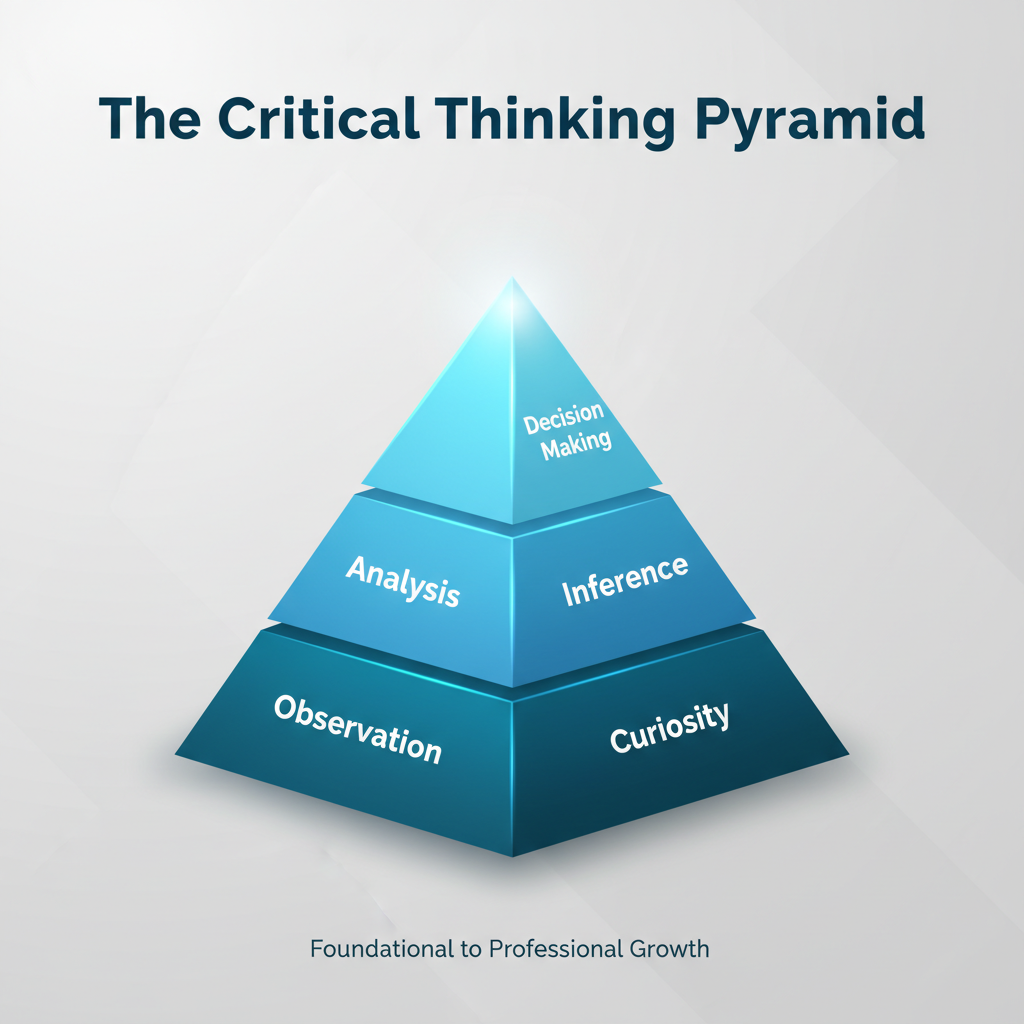
Level 3: The Peak (Goal)
- Decision Making: The ultimate application of critical thinking, using insights to make informed choices.
Level 2: Processing (The Middle)
- Inference: Drawing logical conclusions from analyzed data.
- Analysis: Breaking down complex information into understandable parts.
Level 1: Foundation (The Base)
- Curiosity: The desire to learn and understand the "why" and "how".
- Observation: Accurately noticing details and gathering raw information.
2. The "Stop & Think" Checklist
Use this checklist for decision making in high-pressure jobs.
5 Questions to Ask Before Making a Major Decision
-
Do I have all the facts? Ensure you are not acting on assumptions or incomplete information.
-
What is my bias? Reflect on whether personal feelings or preconceptions are influencing your judgment.
-
What is the counter-argument? Actively consider the opposite perspective or what could go wrong.
-
Who else needs to be consulted? Identify stakeholders or experts whose input could provide valuable clarity.
-
What are the long-term consequences? Look beyond the immediate result to understand the future impact of this choice.
Practical Exercises for Job Seekers
Knowing the theory is good; practice is better. Here is how to sharpen these skills today:
1. The "Devil’s Advocate" Drill
Pick a recent news article you agree with. Now, write down three logical arguments against it. This forces your brain to build new neural pathways and overcome confirmation bias.
2. The Resume "So What?" Test
Look at your resume bullets. For every claim, ask "So what?"
- Draft: "Responsible for managing a team." -> So what?
- Better: "Managed a team of 10." -> So what?
- Critical Thinker: "Managed a team of 10, implementing a new workflow that saved 20 hours per week."
- How JobSeekerTools Helps: Our platform can analyze your resume and suggest these exact kinds of high-impact improvements, ensuring your critical thinking skills shine through.
3. Decode the Job Description
Don't just read a job post; analyze it. If they ask for "fast-paced environment," infer that you need to demonstrate prioritization and stress management. Tailoring your resume to these hidden needs proves you are a critical thinker before you even interview.
Frequently Asked Questions (FAQ)
Can critical thinking be learned, or is it innate?
Critical thinking is absolutely a learnable skill. While some people may be naturally more curious, the ability to analyze, evaluate, and infer can be developed through practice, conscious effort, and the exercises listed above.
Why do employers prioritize critical thinking over technical skills?
Technical skills can be taught quickly, and they become outdated fast. Critical thinking is a transferable "meta-skill" that allows an employee to adapt, learn new systems, and solve unforeseen problems, making them a long-term asset.
How do I demonstrate critical thinking in an interview?
Use the STAR method to tell stories where you faced a complex problem. explicitly mention your thought process: "I noticed X, so I analyzed Y data, which led me to decide Z." Show your working, not just the answer.
Conclusion
Mastering this top ten list to become a critical thinker is the single best investment you can make for your career in 2025. It moves you from being a passive employee to an active leader.
Start small. Pick one skill from the list—like Active Listening or Objective Analysis—and practice it intentionally this week.
Ready to prove your skills? Don't let your resume hide your potential. Use JobSeekerTools to optimize your resume, uncover hidden keywords, and present yourself as the strategic, critical thinker that top companies are desperate to hire.